
Category — Knee
Your Guide to Knee Pain Prevention: Part I
photo by yuan2003
I know what you’re thinking: “You’re broken and all, but my knees work just fine. How do I prevent hobbling around like you?”
Glad you asked. If there were one thing I’d go back and tell my younger self—you know, if someone built a time machine and I somehow got a turn in it—I’d force her to focus on preventive measures. Misery loves company, but I don’t want you to join me in my chronic pain journey. Instead, I want to help you thwart future pain in your knees. Here’s how:
Get to Know Your Feet
Normal arches are actually not that normal. Go figure. Lots of people are like me, with feet that roll inward thanks to low arches. (Some have too-high arches, which brings a host of other problems.) Flat feet can change the mechanics of your whole leg; when your feet roll inward, your knees follow. And a knee that rolls inward no longer tracks along its smooth path. If you have flat feet, prevent maltracking by getting a pair of orthotics. The shoe inserts will shift your stance and help re-align the leg’s position.
Wear Smart Shoes
It’s also important to wear proper shoes. As much as I’d like to believe all shoes—even cheapo Payless ones—were created equal, my knee pain has convinced me that quality matters. A good pair of shoes can give your foot the support it needs, whether you have flat feet or high arches. Plus, ill-fitting shoes can alter the way you run, which in turn puts you at risk for injury.
December 21, 2009 5 Comments
Healthy Link Roundup: Dec. 12
Hope you’ve all had a good week. I’m proud that I got back on the fitness wagon, and I’m vowing now to never let myself take so much time off again. (Hold me to it, will ya?) Before I get to my weekend activities—Christmas shopping, organizing the new apartment, and making a few trips to the gym—I thought I’d leave you with some health articles I enjoyed this week. Check them out when you’re bored at work before you sign off for the weekend.
I love Fit Sugar’s idea for sore feet: Roll your foot over an icy water bottle. I can’t wait to do this after I work out. I’m sure it feels just as good on tired feet as it does on aches.
The LA Times asked three Hollywood fitness pros to pick their top exercise tools. Here’s what they said.
Are canned foods dangerous? This story looks into whether you can ingest a harmful amount of bisphenol-A, a chemical with estrogen that’s been linked to a variety of health problems, by eating canned foods.
Vitamin G dug up a silly sugar ad from the ’60s. According to the makers, all kids need sugar to keep their energy going all day long. And I quote: “Play it safe with your young ones. Make sure they get sugar every day!”
The Center for Science in the Public Interest lists the 10 best health foods. But the best part of the list is the 10 worst foods. No. 5: Cheesecake Factory chocolate cake. One slice weighs in at ¾ of a pound (no joke) and has 1,550 calories. Yikes.
Wear and tear isn’t the only thing that will cause cartilage damage to the knee. This story explains why researchers say that other injuries, like ACL tears, can lead to early arthritis.
Think your chicken’s safe to eat? Read about a Consumer Reports study on the deadly bacteria it probably harbors, then be extra careful to cook it to an internal temp of 165. That, and make sure the juices don’t touch other foods. (I treat raw chicken like the Ebola virus, so I’m pretty sure my kitchen’s safe.)
My weekend’s starting now! What are your plans?
December 12, 2009 2 Comments
Foam Roller: Object of Torture or Genius Fitness Tool?

photo from reebok
My foam roller looks innocent. It’s lightweight and purple and reminds me of a yoga mat, which reminds me of deep breathing. It’s crazy how such a harmless hunk of foam can create so much pain when your muscles are crunched up into little knots.
If you’re a runner, you should know what I’m talking about. Weekend warriors can still be tight, for sure, but runners typically have those telltale trouble spots: quads, hamstrings, hips, and outer thigh. Because stretching can’t conquer muscle knots, it’s important to work them out by massage. A deep tissue massage tackles the knots and breaks them up.
As much as I’d love to get a weekly deep tissue massage (and I’d love to, so if you want to donate to my tension-relief fund, go ahead), it’s not practical for my lack of budget. Instead, I use my foam roller. It’s the next best thing.
After a workout, I roll my thighs, hamstrings, and IT band—that one sends shockwaves down my leg hurts the most. After that, I stretch. My foam roller helps my flexibility and eases knee pain when my muscles are especially tight. In fact, I can usually feel a difference in my knee right after rolling.
So, how do you, um, roll yourself silly? Below, I’ve listed three moves that’ll loosen knots…
December 10, 2009 2 Comments
Take That, Laziness. I’m Back at the Gym.

I would just like to start by saying … I did it!
Yep, I got my butt (and The Man’s) to the gym last night and broke my stretch of stupidity fast. I think the best way to get over a slump is to just do it. This afternoon, as my legs ached from strength training, I was reminded why I love the gym. And that made me excited to go again tonight.
So, what does a gimp do at the gym after being away for too long? Primarily, I took it slow. As tempted as I was to resume my workouts as I had been doing them before PRP, I decided it would be smarter to ease into physical therapy. Here’s what I did:
Warm up: 10 minutes on the recumbent bike. I was hoping to snag a regular exercise bike but, alas, those were all occupied. I set the level high because my gym’s bikes glide too easy, which—strange as it sounds—hurts my knees even more.
Leg press: I did two sets of 15 on each leg with 40 pounds on the machine. The right leg pressed like a champ, but the left was a wimp.
December 9, 2009 7 Comments
Fitness Slump: How Do You Stay Motivated?

photo by timtak
Maybe if I buy some supercool shoes I’d want to work out.
I’m not a liar. (OK, I lied to The Man about my love—or tolerance—of sports when we first started dating. But whatever.) My main point here is that I won’t lie to you. I started this blog to journal the ups and downs of living with knee pain. I wanted to mark the fitness and nutrition and emotional aspects of living healthy. I set out to chronicle my journey through PRP, PT, and whatever other acronyms come my way. But…
I have to admit: I’ve put off posting about my knees on purpose. That’s because it’s my fault they’re sore. I’ve skipped the gym for an embarrassingly long time. Sure, I had some good reasons at first: PRP, a chest cold, a 10-day headache, packing up my old place, and moving into my new place. But I haven’t gone back since moving even though I’m fully capable. Frankly, I don’t feel like it.
Back in the day—you know, summer of ’09—I looked forward to exercising after work. Whether I’d hit up the gym or the couch wasn’t a question; I came home, changed, then got The Man and myself over to the gym faster than you could say “dinnertime.” Now, after being out of practice, the motivation isn’t there. I’ve been meaning to get back to the gym for weeks, but somehow everything else in life has bumped the gym to the bottom of my Must Do Or Else list—things like unpacking boxes, organizing new drawers and cabinets, researching closet shelves, and, um, relaxing.
I’m hoping (crossing my fingers on both hands, which is making typing a little hard) this post will shame me into getting me to the gym. As in, I can’t face you tomorrow with a big, fat lie. So, I’m going tonight and I’ll write about my experience tomorrow. There—I’m locked in. (I hope.)
I hope I can kick-start my motivation simply by forcing myself to just go. But how do you get out of an I-don’t-wanna-exercise funk? Do you have any tips to get motivated?
December 8, 2009 5 Comments
Weak Muscles Can Lead to Runner’s Knee. That, And Really Bad Luck.

I covet athletes’ bulging thighs. That’s right. You heard me. I don’t dream of having Gwen Stefani’s abs or Madonna’s biceps. OK, maybe a little. But what I really want is strong, muscular thighs. (Though I hope mine are a little less masculine than the ones in the photo above.)
A new study confirms something my doctor told me more than a year ago: Weak leg muscles contribute to Runner’s Knee, a layman’s term for the oh-so-fun cartilage condition I have.
If I didn’t hate my knees so much, I’d call them something like remarkable or incredible. If I were to call them that, I’d do it because these tiny disk-like bones are what allow you to walk, bend your legs, and lift heavy objects. See, without them your thighs would fall onto your shins, making it really hard to do things like sit. And making you look really, really, ridiculously funny.
So about those knees … They’re connected to your upper and lower legs by tendons and ligaments. I imagine them like rubber bands, connecting the whole shebang. You can think of them however you like.
December 3, 2009 12 Comments
To Stretch Or Not To Stretch?
photo by leo.prie.to
I never was interested in stretching until my physical therapist told me a secret. Too-tight muscles can cause injuries. She gave me a few stretches to do each day after I exercised, and they quickly became part of my PT ritual. I won’t lie: I let my eyes roll to the far, far reaches of my skull when I realized stretching added another 10 minutes to my already long PT routine. But after the first couple times, my knees started feeling better. Loosened hamstrings and calf muscles made walking less painful. Now, if I don’t stretch I feel uncomfortably tight. And I believe the stretching helps prevent further knee pain.
So, of course you can imagine how stunned I was to read this New York Times article that says stretching is pretty much worthless. The study of college track and field runners found that those with tighter muscles have better running economy, which measures how much oxygen a person uses in motion. The researchers say tight muscles store and use energy better, making running easier.
December 1, 2009 2 Comments
A Case of the Mondays: Humiliation and Hopelessness
photo by rachelcreative
As much as I loved Thanksgiving—a lot, especially since the dessert table had five pies—it reminded me of a few things I’m not too happy about. And if I can’t whine on this blog, then where can I? Besides, it’s a rainy Monday. That alone deserves a little bit of complaining.
Here’s my gripe: The whole act of getting from Virginia to Massachusetts is humiliating when your knees are lined with chewed-up cartilage. Forget that sitting for an hour and a half on an airplane makes my joints feel like a vice is tightening my insides. The problem is my mode of transportation.
You see, I have to use a wheelchair. No big deal, you say. You’ve got to do what you’ve got to do to heal your knees. That’s what I thought the first time I parked my butt in one. But once you’re in the seat you realize it is a big deal. People look at you differently. Some soften their eyes like they feel bad that someone so young is trapped in a moving chair. Others are accusatory, as if my normal appearance means I’m faking the whole deal in order to skip the line at the Southwest gate. Even if people aren’t thinking I’m a loser, I feel like they are.
Some people tell me not to pay attention to what other people think. It’s easy to say when you’ve never rode a wheelchair. Maybe this is what overweight people feel, as if everyone is noticing their extra pounds and judging them for it. Maybe this is how other people with disabilities—missing limbs, paralysis, or even a limp—feel when they go through the airport. I sympathize with them.
In the end, it makes me feel crummy about my knees, about the fact they’re not fixed yet, and about the prospect of them never being fixed. Since my move, they’ve been sore and easily swollen, and I’m feeling closer to 85 than I am to 27. I fear they’ll never be fixed, that I’ll be wheeling through the airport for the rest of my life.
I’m hoping this feeling will pass, but for now, how do you get over hopelessness? Do you ever feel humiliated because of your body? What’s your solution?
November 30, 2009 4 Comments
Healthy Link Roundup
photo by mtsofan
It’s finally Friday (is it just me, or did this week go really sloooow?), so I’m finishing up work then spending the weekend tackling the massive box-fest that is my living room. If you’re bored at work you have a few spare minutes before your weekend kicks into full swing, check out some stories from around the Web.
I’ve never been a huge fan of pumpkin pie—why bother when pecan’s on the table, too?—but these chocolate chip pumpkin spice bars sound amazing. Plain and simple.
I love this leg-strengthening move that focuses on balance. Just make sure your knee never goes over your toe line as you squat.
I’m no Top Chef, so these kitchen tricks were super helpful. Here’s one: Keep celery fresh for weeks by wrapping it in Tinfoil before putting it in the fridge.
Researchers say exercise can make you less anxious. In my experience, it also reduces stress and ups body image.
If you envy Gwen Stefani’s abs (and, really, who doesn’t?), check out this in-depth interview with her personal trainer. Then whine a bit because you can’t afford a trainer.
November 20, 2009 2 Comments
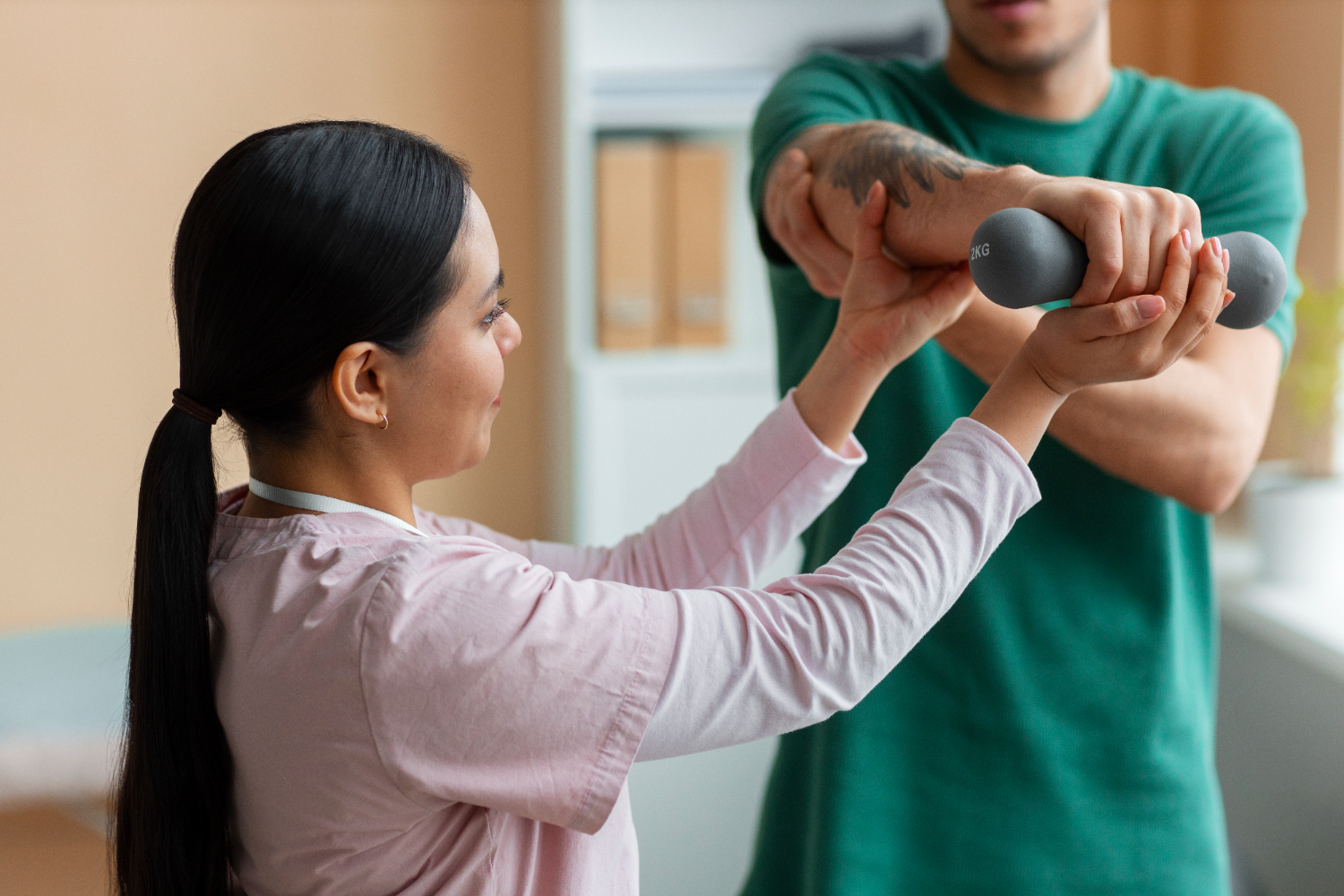
All You Ever Wanted to Know About Physical Therapy. Plus 9 Ways to Know If Your PT is Right For You.

photo by the one true b!x
If you’ve never been to a physical therapist, lucky you. That means you’re in pretty good shape. (Wanna share the good fortune with a friend?) In case you recently walked under a ladder, broke a few mirrors, and opened an umbrella in the house, I’ve written this guide to finding and making the most of physical therapy.
What is physical therapy?
The physical therapy (that’s PT in injured-human speak) specialty focuses on injury rehabilitation. The goal of PT is to improve physical functioning, like walking up a flight of stairs for someone with a meniscus tear, swinging a tennis racket for someone with shoulder tendonitis, or writing with a pen for someone with a hand fracture.
What does a physical therapist do?
Physical therapists are trained in the musculoskeletal system and will diagnose and treat injuries and muscle imbalances. A therapist’s toolbox includes exercise, physical manipulation (nothing crazy here; think moving a limb to improve range of motion), heat, ice, and some wackier devices—more on those later.
Where can you find a physical therapist?
Chances are, if you’re in enough pain to need a physical therapist, you’re in enough pain to visit a doctor. And though most states don’t require you get a doctor’s note before signing up for PT (my second didn’t need a scrip, my last did), it’s a good idea to see your doctor beforehand. Many will have a list of preferred therapists they work with and trust—mine did. Some physical therapists work in doctor’s offices or hospitals, and others work out of private practices or gyms.
November 19, 2009 No Comments